
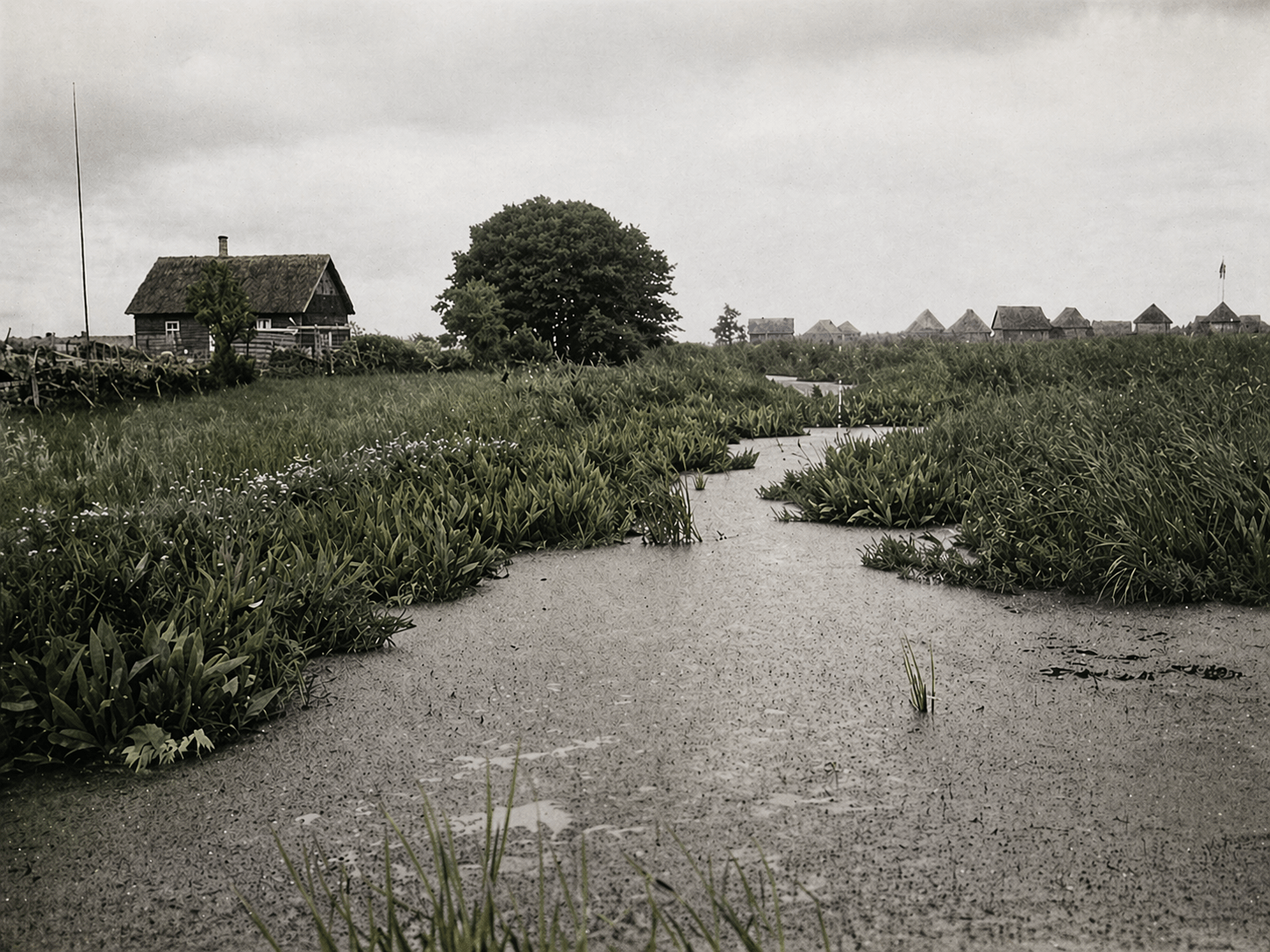
The Salme ship burials are located on Saaremaa, in the narrowest part of the Sõrve Peninsula. The site was discovered in the schoolyard on land that previously belonged to a local farm. The farm was destroyed in 1941 during Red Army operations.
Based on radiocarbon analysis, the ship burials have been dated to the beginning of the Viking Age, approximately between 720 and 800 AD. This is exceptional in both the Estonian and wider European context, as the event predates the traditionally recognized start of the Viking Age marked by the raid on Lindisfarne in 793 AD.
The two ships were located fairly close to one another along the Salme River. As late as the medieval period, the river formed part of a strait separating the Sõrve Peninsula from the rest of Saaremaa. At least 8 individuals were buried in Ship I and at least 34 in Ship II. Animals were buried with them as well, including at least six dogs, along with a rich assortment of grave goods. Among the grave goods was a double-edged sword that inspired some of the exhibited patterns; its decorations became visible through X-ray examination.
The excavations and analyses conducted so far have provided a great deal of information, but they have also raised many new questions. Who were the men buried in these ships? Current research suggests they were not locals. Most of them died violently, but who attacked them and who buried them? Was Saaremaa primarily a friendly stopping place where an unexpected conflict occurred? It is still unclear whether all the burials originated from a single event or whether they took place over a longer period of time. The inclusion of animals both as food and companions points to complex beliefs and rituals whose meaning is still not fully understood.
The Salme ship burials are among the most unique archaeological discoveries in our region, yet many questions remain unanswered. In recent years, research has gained new momentum, and new scientific methods offer hope of finding answers. The results will certainly be discussed in future SÕBA posts.
Lõugas, L. and Luik, H. eds., 2023. The Salme Ship Burials: Two Eighth-century Mass Graves on Saaremaa Island, Estonia: Fieldwork and Catalogue. Tallinn. The Salme ship burials : two eighth-century mass graves on Saaremaa island, Estonia.
Price, T.D., Peets, J., Allmäe, R., Maldre, L. and Oras, E., 2016. Isotopic provenancing of the Salme ship burials in Pre-Viking Age Estonia. — Antiquity, 90(352), 1022-1037. https://doi.org/10.15184/aqy.2016.106.
Luik, H., Peets, J., Ljungkvist, J., Maldre, L., Maldre, R., Allmäe, R., Munoz-Rodriguez, M., McGrath, K., Speller, C. and Ashby, S., 2020. Antler combs from the Salme ship burials: Find context, origin, dating and manufacture. — Estonian Journal of Archaeology, 24(1), 3-44. https://doi.org/10.3176/arch.2020.1.01.
Price, T.D., Peets, J., Allmäe, R., Maldre, L. and Price, N., 2020. Human remains, context, and place of origin for the Salme, Estonia, boat burials. — Journal of Anthropological Archaeology, 58, 101-149. https://doi.org/10.1016/j.jaa.2020.101149.
Nirgi, T., Grudzinska, I., Kalińska, E., Konsa, M., Jõeleht, A., Alexanderson, H., Hang, T. and Rosentau, A., 2022. Late-Holocene relative sea-level changes and palaeoenvironment of the Pre-Viking Age ship burials in Salme, Saaremaa Island, eastern Baltic Sea. — The Holocene, 32(4), 237-253. https://doi.org/10.1177/09596836211066596.
Bunker, M. Mõõganupp.
Salme jõgi. 1930. EFA.554.0.185747.
SM 10602:419 A, https://www.muis.ee/en_GB/museaalview/2896643.
Toome, T. Röntgen.
Patterns
In the Salme II ship burial, the men had been placed very closely beside one another and in several layers, making it difficult to determine which objects belonged to whom. At the same time, the entire burial site shows that the funerary arrangements were carefully planned. The deceased were positioned in the ship according to a specific order, mostly lying on their backs and aligned along the ship’s axis.
Among those buried in the ship were four brothers. They had been buried side by side, and fragments of an ornate double-edged sword were uncovered near one of them. The sword’s hilt was made of gilded bronze and decorated with fine gold wire. The pommel depicts a mythical animal: along the sides of its curved back, paws, limbs, and a striped body can be seen. Two red almandine garnets mark the creature’s eyes, and polished gemstones continue in a row along its back.
X-ray examination of the sword revealed patterns forged into the blade that had become invisible to the naked eye due to corrosion.


